

A Franchise Agreement is a sort of agreement that is mainly used between the brand owner and the franchise holder. This Franchise Agreement Template will help you a lot. Take for example a franchise agreement happening between Subway, which is a brand, and a subway franchise holder. This type of agreement has its own set of terms and conditions. The best part is that it is legal and is done by keeping all of the important points in mind. The main benefit of having such agreement is that standard rules and regulations are followed. It also helps the brand owner to maintain a decent level of sanity. Apart from set terms and conditions such agreement also consist of franchise disclosure agreement also called as FDD and Uniform Franchise offering circular also called as UFOC. It also consists of a disclosure to be made by both parties, which is required as per state laws.
You can also browse our full collection of free agreement templates for more ready-to-use designs.
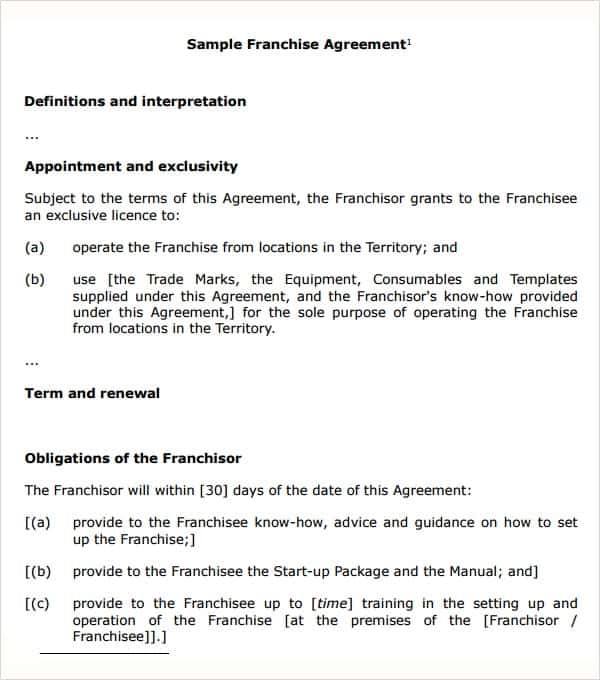
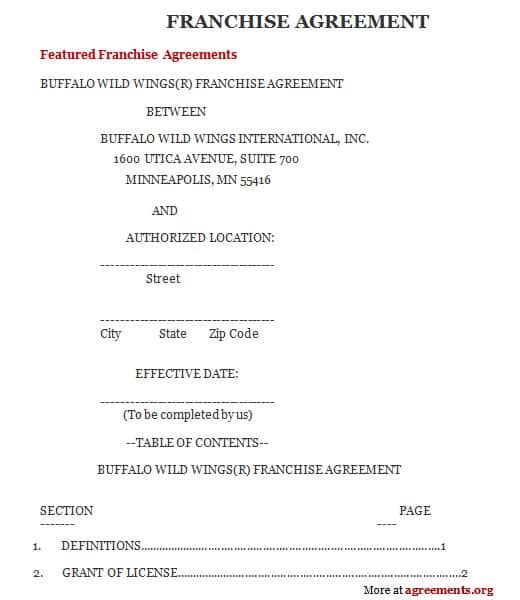
Download this Franchise Agreement Template below. Franchise Agreement is an agreement or written contract between two parties, franchisor and franchisee. A franchise agreement clearly defines the terms and conditions that both the franchisee and franchisor must understand and accept. It also explains in detail what the franchisor expects from you. Both parties the franchisor and the franchisee must sign the franchise agreement, as it is the legal business document that binds the two parties. Franchise agreement is not available in standard form because the terms, conditions, and the methods of operations of various franchises are different on the base of business. If you need to draw franchise agreement for your business or company, you can use franchise agreement templates and samples available on internet. You can make a perfect franchise agreement for your company by simply adding some important information, terms and conditions into franchise agreement templates as per your needs.
Key Elements of a Solid Franchise Agreement
A well-drafted franchise agreement should clearly identify the franchisor and franchisee, define the brand, system, and trademarks being licensed, and set out the initial franchise fee along with ongoing royalty payments. It should also spell out the exact territory the franchisee is permitted to operate in, whether that territory is exclusive, and how the franchisor will support the franchisee through training, marketing, and day-to-day operations. Good templates include a clear term length with renewal conditions, quality-control standards the franchisee must follow, and a detailed section on what happens if either party wants to end the relationship early. Finally, it should specify which state or country’s law governs the agreement and how disputes will be resolved if one side believes the other has broken the terms.
Single-Unit vs. Multi-Unit Franchise Agreements
A single-unit franchise agreement grants the franchisee the right to open and run one location under the franchisor’s brand, which is the most common starting point for a new franchisee. A multi-unit or area development agreement, by contrast, allows a franchisee to open several locations within a defined territory, usually according to a development schedule that sets deadlines for how many units must open by a given date. Multi-unit agreements typically carry lower per-unit fees in exchange for the franchisee committing capital and taking on more risk across multiple sites. Choosing the wrong format matters: signing a single-unit agreement when the goal is regional expansion means renegotiating fees and territory rights later, while committing to a multi-unit development schedule without the capital to support it can put the franchisee in breach of the agreement.
When Businesses Typically Need a Franchise Agreement
Franchise agreements come up whenever an established brand wants to expand through independent operators rather than opening company-owned locations. A franchisor uses one every time it brings on a new franchisee, whether that is a single restaurant location, a retail store, or a service business operating under the parent brand. Franchisees need to review one closely before committing capital to a location, staff, and buildout, since the agreement is what defines their rights, obligations, and the fees they will pay for the life of the relationship. The agreement is also central during franchise renewals, ownership transfers, and any renegotiation of territory or fee terms as the relationship matures.
How to Fill Out a Franchise Agreement Template
- Fill in the full legal names, addresses, and business entity details of the franchisor and the franchisee.
- Confirm the franchise fee, ongoing royalty percentage, and any marketing or advertising fund contributions.
- Define the exact territory the franchisee will operate in and state whether that territory is exclusive.
- Set the term of the agreement, along with the conditions under which it can be renewed.
- List the training, support, and operational standards the franchisor will provide and require.
- Specify the trademark and branding usage rules the franchisee must follow.
- Add the termination conditions, including what happens to signage, equipment, and confidential materials if the agreement ends.
- Specify the governing law and dispute resolution process, then have both parties sign and date the agreement.
Common Mistakes to Avoid
- Signing without fully understanding the ongoing royalty and marketing fee obligations.
- Overlooking territory restrictions that could limit future expansion.
- Not reviewing the franchise disclosure document (FDD) alongside the agreement itself.
- Ignoring the termination and non-compete clauses until a dispute arises.
- Assuming a generic template covers state-specific franchise disclosure requirements without verifying it.
This template is provided for general informational purposes and is not a substitute for legal advice. Consult a qualified attorney before finalizing any franchise agreement.
Frequently Asked Questions
Is a franchise agreement the same as a franchise disclosure document (FDD)?
No. The FDD is a disclosure document the franchisor must provide before the sale, covering financial performance, litigation history, and fees. The franchise agreement is the actual binding contract signed once both parties agree to move forward.
How long does a typical franchise agreement last?
Most franchise agreements run for five to twenty years, commonly ten, with renewal options that may require paying a renewal fee and meeting updated brand standards.
Can a franchise agreement be terminated early?
Yes, but usually only for specific reasons stated in the agreement, such as failure to pay royalties, repeated brand-standard violations, or bankruptcy. Early termination outside those conditions can trigger penalties for either side.
Can I negotiate the terms of a franchise agreement?
Some terms, such as territory size or the development schedule for multi-unit deals, are sometimes negotiable, though core terms like royalty rates and brand standards are typically standardized across all franchisees to keep the system consistent.
Free Franchise Agreement Template:

Click on the download button and make this franchise agreement template your own.

Get More Franchise Agreement Templates Here
1. Contracts.Onecle


2. Franchiseworld
3. RocketLawyer

4. Biztree
5. Freefranchisedocs

Related templates you may find useful: free non-disclosure agreement templates, free loan agreement templates and free employment agreement templates.