

A remittance template is a ready-made document that can be used to record, communicate, or confirm a payment or money transfer. In business accounting, the term is commonly associated with a remittance advice, which provides information about a payment and helps the recipient identify which invoice or account the payment relates to.
A well-designed remittance document can make payment processing easier for both businesses and customers. Instead of creating a payment notification from scratch, you can use a remittance advice template to organize the payment details in a clear and professional format.
On this page, you can download a free remittance template and customize it according to your requirements. The template can be useful for businesses, accounting departments, suppliers, customers, and individuals who need a simple way to document payment information.
What Is a Remittance?
The word remittance generally refers to money that is sent from one person or organization to another. It can describe payments made to settle an obligation, transfers between individuals, or money sent across countries.
For example, a person working abroad may send money to family members in their home country. Businesses also use the term when referring to payments made to suppliers, vendors, service providers, or other organizations.
In accounting and business communication, however, remittance advice has a more specific meaning. It is information sent to a supplier or creditor to explain that a payment has been made and identify the invoices or accounts covered by that payment.
What Is Remittance Advice?
Remittance advice is a document or electronic message that provides details about a payment.
For example, a company may pay a supplier for three outstanding invoices. The company can send a remittance advice explaining:
- Who made the payment
- Who received the payment
- Payment date
- Payment amount
- Payment method
- Invoice numbers
- Amount allocated to each invoice
- Reference or transaction number
- Remaining balance, if applicable
Remittance advice is not necessarily a requirement for every payment, but it can be extremely useful for maintaining accurate accounts receivable and accounts payable records.
The current page specifically describes remittance advice as a business document that can show that an invoice has been paid and identify the method of payment.
Free Remittance Template
A free remittance template gives you a convenient starting point for creating a professional payment notification or remittance document.
Instead of designing the document yourself, you can download the template and replace the sample information with your own details.
Depending on your needs, you can add your company name, logo, customer information, supplier information, payment details, invoice references, and other accounting information.
A reusable template is particularly helpful for businesses that process payments regularly and want their payment communications to follow a consistent format.
Why Use a Remittance Advice Template?
A professional remittance advice template can make payment communication clearer and reduce confusion between the payer and recipient.
Some important benefits include:
- Saves time when preparing payment notifications
- Creates a consistent payment format
- Helps identify invoices covered by a payment
- Makes accounting records easier to understand
- Reduces payment reconciliation problems
- Provides a useful record for both parties
- Makes business communication look more professional
- Helps accounts departments process payments efficiently
For businesses handling numerous invoices, providing detailed remittance information can be particularly useful.
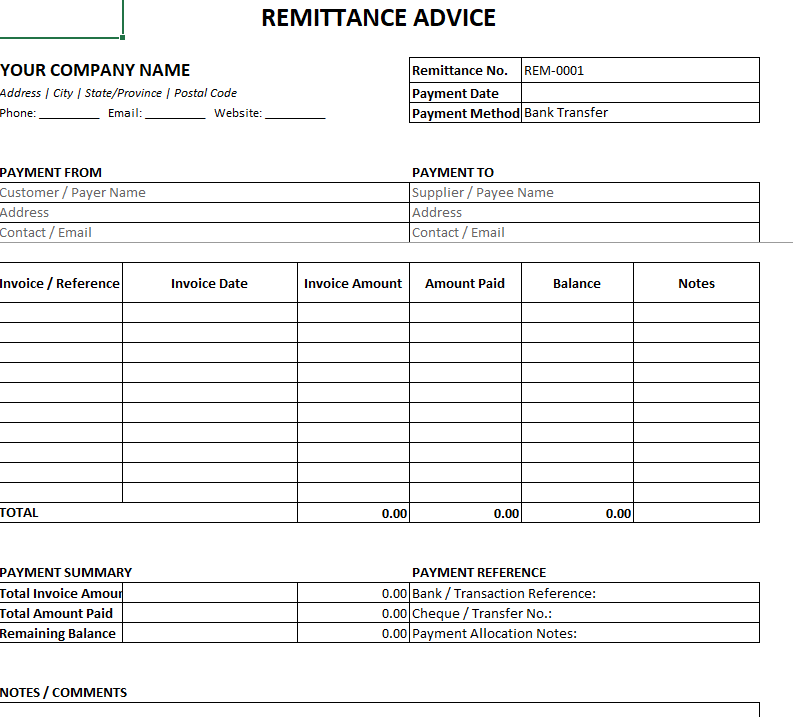
Remittance Advice Template Format
There is no single format that every organization must use, but a professional remittance advice usually contains several basic sections.
Payer Information
Include the name and contact information of the person or company making the payment.
Payee Information
Identify the supplier, vendor, creditor, or other party receiving the payment.
Payment Date
Record the date on which the payment was made or processed.
Payment Amount
Clearly state the total amount being remitted.
Payment Method
Identify whether the payment was made by bank transfer, cheque, card, electronic payment, or another method.
Invoice Details
If the payment is being used to settle one or more invoices, list the relevant invoice numbers and amounts.
Reference Number
A transaction, cheque, bank, or payment reference can help both parties identify the payment later.
Notes
Additional notes can be included when necessary, such as partial payment information, deductions, credits, or instructions.
Sample Remittance Advice
A simple remittance advice example might look like this:
Remittance Advice
From: ABC Company
To: XYZ Supplies
Payment Date: August 25, 2026
Payment Method: Bank Transfer
Payment Reference: TRX-10254
| Invoice | Invoice Amount | Amount Paid |
|---|---|---|
| INV-1001 | $1,500 | $1,500 |
| INV-1008 | $850 | $850 |
| INV-1012 | $650 | $650 |
Total Payment: $3,000
This simple structure allows the recipient’s accounting department to understand what the payment represents without having to contact the payer for clarification.
Remittance Template for Business
A business remittance template can be useful for companies that regularly pay suppliers or receive payments from customers.
For example, an accounts payable department can prepare a remittance advice whenever a group of supplier invoices has been paid. The document can then be sent to the supplier so its accounts receivable team knows which invoices should be marked as paid.
Similarly, a company receiving payments may use remittance information supplied by customers to reconcile incoming funds with outstanding invoices.
Remittance Advice for Invoice Payments
One of the most common uses of remittance advice is to accompany an invoice payment.
Imagine that a customer has five unpaid invoices but sends one combined bank transfer. Without additional information, the supplier may not immediately know which invoices the payment is intended to settle.
A remittance advice solves this problem by listing the invoice numbers and the corresponding amounts.
This makes the reconciliation process faster and gives both businesses a clearer financial record.
Remittance Slip
A remittance slip is another term that may be used for a document containing payment or remittance information.
Depending on the organization, a remittance slip may accompany a payment, be included with a statement, or provide a reference for identifying a transaction.
The exact information included depends on the purpose of the document and the accounting process used by the business.
Remittance Template in Word
A remittance template in Word is useful when you want a document that can be edited and customized easily.
Microsoft Word allows you to change the payer and recipient information, add your company branding, modify payment fields, and adjust the layout according to your accounting procedures.
A Word template is also convenient if the completed remittance advice needs to be printed or converted into PDF before being sent to the recipient.
Remittance Template in Excel
An Excel remittance template can be particularly useful when payment information contains multiple invoices or transactions.
Excel makes it easier to work with tables and numerical information. You can create columns for invoice numbers, invoice dates, amounts, payments, balances, and other accounting information.
For businesses processing many transactions, a spreadsheet-based remittance format may also make sorting and organizing payment data easier.
Remittance Advice vs. Receipt
A remittance advice and a receipt are related to payments but serve different purposes.
A remittance advice generally communicates information about a payment and explains which invoices or accounts the payment relates to.
A receipt generally serves as confirmation that a payment has been received.
For example, a customer may send a remittance advice to a supplier after making a bank transfer. The supplier may subsequently issue a receipt or update its accounting records to confirm receipt of the payment.
How to Create a Remittance Advice
Creating a professional remittance advice is straightforward if you use a consistent format.
1. Add the Company Information
Start with the name and contact details of the payer and recipient.
2. Enter the Payment Details
Add the payment date, amount, payment method, and transaction or reference number.
3. Identify the Invoices
List each invoice being paid and indicate the amount allocated to each invoice.
4. Calculate the Total
Make sure the individual amounts match the total payment.
5. Add Notes if Necessary
If the payment is partial or includes credits, deductions, or other adjustments, explain them clearly.
6. Review Before Sending
Check all invoice numbers, payment amounts, dates, and references before sending the remittance advice.
Accurate information is especially important because the recipient may use the document to update its accounting records.
When Should You Send Remittance Advice?
Remittance advice can be sent when a payment has been made or processed, particularly when the payment covers multiple invoices.
It can be especially useful when:
- One payment covers several invoices
- The payment amount differs from the invoice total
- A partial payment has been made
- Credits or deductions have been applied
- The supplier needs payment allocation information
- The company regularly communicates payment details
Not every payment requires a separate remittance advice, but providing one can make reconciliation easier.
Download the Free Remittance Template
If you need a simple remittance template for documenting or communicating payment information, the downloadable template on this page provides a starting point that you can customize for your own requirements.
Add your company information, payment details, invoice references, and other relevant information before sending the completed document to the recipient.
Whether you are looking for a remittance advice template, payment remittance template, remittance slip, or business remittance form, using a consistent format can help improve communication between your accounting department, customers, and suppliers.
Download free Remittance Template:
The template is intended to provide a ready-made document for recording or communicating remittance and payment information. It can be customized with the relevant payer and recipient details, payment information, invoice references, and other accounting data required for the transaction.
This type of template can be useful for businesses and accounting departments that need to notify suppliers or other recipients about payments. It provides a structured starting point that can be adapted to the organization’s own payment and reconciliation process.

Click on the download button and make this remittance template your own.

See More Remittance Templates Here
Frequently Asked Questions
What is a remittance template?
A remittance template is a ready-made document used to record or communicate payment information. It can include payer details, recipient information, payment amounts, invoice numbers, payment dates, and transaction references.
What is a remittance advice?
A remittance advice is a document or electronic message sent with or after a payment to explain the payment details and identify the invoices or accounts being paid.
Is remittance advice the same as a receipt?
No. Remittance advice usually explains or identifies a payment, while a receipt generally confirms that a payment has been received.
What information should a remittance advice include?
It commonly includes the payer, payee, payment date, payment amount, payment method, invoice numbers, amounts paid, and payment reference. Additional information can be added when necessary.
Can I create a remittance template in Word?
Yes. Word is suitable for creating an editable remittance template that can be customized with company information, payment details, invoice references, and other fields.
Can I create a remittance template in Excel?
Yes. Excel can be particularly useful when a payment covers multiple invoices because you can organize invoice numbers, amounts, balances, and payment allocations in a table.
When should a company send remittance advice?
It is particularly useful when one payment covers multiple invoices, when a payment is partial, or when the recipient needs information to reconcile the payment with its accounting records.
Is remittance advice mandatory?
Not necessarily. Requirements can vary depending on the transaction, industry, agreement, and applicable rules. Even when it is not mandatory, remittance advice can make payment reconciliation easier.