

Action Plan Templates are added here in our templates collection. When time comes for taking strict action against anything then at that time if you are not prepared enough then you will lose the task badly. Its very much important to be always prepared for the worst. You may hope for the best but always be prepared for the worst situation that ever can come. All the companies who manage an efficient action plan are seen to be recover very well in difficult times. We do hope that our this action plan template will be useful and beneficial for you. These Action Plan Templates will help and guide you in your action plans.
A plan is a set of steps to accomplish a specific task effectively. A plan is also a strategy or road map to achieve a goal or objective. Making a perfect plan can help you to achieve your goal in time without facing any problem and also indicates that what to be done, when, how and by whom. A plan for doing something can also decrease the financial problems. Making a plan creates a healthy attitude towards work environment which helps in boosting your moral and efficiency towards your goal. For example, before starting a business you should make a perfect plan that what kind of business you want to start and how you can start and manage it effectively. Planning also highlights the purposes for which various activities are to be started. A perfect plan leads to best utilization of possible resources and elements. You can get these Action Plan Templatse free here.
What Is an Action Plan?
An action plan is a documented, step-by-step outline that translates a goal into a concrete sequence of tasks, assigned owners, deadlines, and required resources. Rather than stating an intention such as “grow revenue” or “finish the marketing campaign,” an action plan spells out exactly what will be done, who will do it, by when, and how progress will be measured. It exists to close the gap between deciding on an objective and actually achieving it, turning abstract ambition into a workable roadmap that a person or team can follow day by day.
You can also browse our full collection of free plan templates for more ready-to-use designs.
The core purpose of an action plan is accountability and clarity. When everyone involved can see the same list of tasks, owners, and dates, there is far less room for miscommunication, duplicated effort, or tasks quietly falling through the cracks. A good action plan also acts as a checkpoint tool: because each task has a defined completion criterion, you can tell at a glance whether a project is on schedule, running behind, or ready to move to its next phase.
Who Uses Action Plans?
Action plans are used far beyond the corporate boardroom. Project managers rely on them to break large initiatives into manageable milestones and to keep stakeholders aligned on what happens next. Team leads use them to coordinate cross-functional work, ensuring that marketing, sales, product, and operations are all pulling toward the same deadline. Individuals use action plans for personal goals such as a fitness program, a career change, a home renovation, or a financial savings target. Students and educators use them to plan research projects, dissertations, and semester-long assignments, while nonprofit organizations use action plans to structure grant-funded initiatives and community programs where funders expect a clear timeline and measurable outcomes.
Key Elements of a Strong Action Plan
Not every list of tasks qualifies as an effective action plan. The strongest ones consistently include six elements: a clearly stated goal that defines what success looks like; a breakdown of the specific tasks and sub-tasks required to reach that goal; a named owner for every task, so responsibility is never ambiguous; a realistic deadline for each task as well as an overall target date; the resources, budget, or tools each task depends on; and a defined success metric or checkpoint that tells you when a task, and ultimately the whole plan, is genuinely complete. Leaving out any one of these elements is usually what causes a plan to stall, because the missing piece, often the owner or the deadline, is exactly the piece that keeps work moving.
How to Build an Action Plan Using a Template
Starting from a template rather than a blank page saves time and ensures nothing important gets left out. Begin by writing your goal in one specific, measurable sentence at the top of the template. Next, list every task needed to reach that goal, breaking large tasks into smaller sub-tasks wherever a single step would otherwise take more than a few days. Assign one owner to each task, since shared ownership almost always means no one takes charge. Add a deadline to every task, working backward from your final target date so earlier tasks have enough lead time. Note any resources, approvals, or budget each task needs before it can start, and finally decide how you will track progress, whether that is a weekly check-in, a shared spreadsheet, or a project management tool. Once the template is filled in, review it with everyone involved before work begins, so the plan reflects what people can realistically deliver rather than what looks good on paper.
Common Mistakes to Avoid
The most frequent action-plan failure is a vague goal: “improve customer service” gives no way to know when you have succeeded, whereas “reduce average support response time to under two hours by the end of Q3” does. Another common mistake is listing tasks with no named owner, which quietly guarantees that no one feels responsible for finishing them. Plans also fail when deadlines are missing or unrealistic, when they ignore the resources a task actually requires, and when there is no follow-up mechanism, since a plan that is written once and never revisited stops reflecting reality within a few weeks. Finally, cramming too many priorities into one plan dilutes focus; a plan with three to five well-defined goals is usually more effective than one trying to track fifteen.
Practical Tips for a More Effective Plan
Write every goal using the SMART framework, Specific, Measurable, Achievable, Relevant, and Time-bound, so that anyone reading it understands exactly what “done” means. Keep the plan visible to everyone involved, whether that is a shared document, a printed copy on a wall, or a project management board, since a plan no one looks at cannot guide anyone’s work. Schedule a short recurring check-in, weekly or biweekly depending on the project’s length, to update task status and flag anything falling behind. Track progress against the original deadlines rather than quietly resetting dates, since a running record of what slipped and why is one of the most useful things a team can learn from. Finally, keep the plan as simple as the goal allows; extra columns and categories that no one updates add clutter without adding value.
Frequently Asked Questions
What is the difference between an action plan and a to-do list?
A to-do list is a simple collection of tasks, while an action plan ties each task to a specific goal, an owner, a deadline, and a measure of success, so it functions as a complete roadmap rather than a loose checklist.
How long should an action plan be?
Length should match the size of the goal. A personal goal may fit on a single page, while a department-wide initiative may run several pages with sub-plans for each team, but in both cases every task should still have an owner and a date.
Can one action plan template work for any type of goal?
A well-structured template built around goal, tasks, owners, deadlines, resources, and success metrics can be adapted to almost any goal, business, academic, or personal, by changing the content rather than the structure.
How often should an action plan be reviewed?
Most plans benefit from a review at least every one to two weeks, since goals, deadlines, and available resources can shift, and a plan that isn’t updated quickly stops matching what is actually happening.
Download free Action Plan Templates:
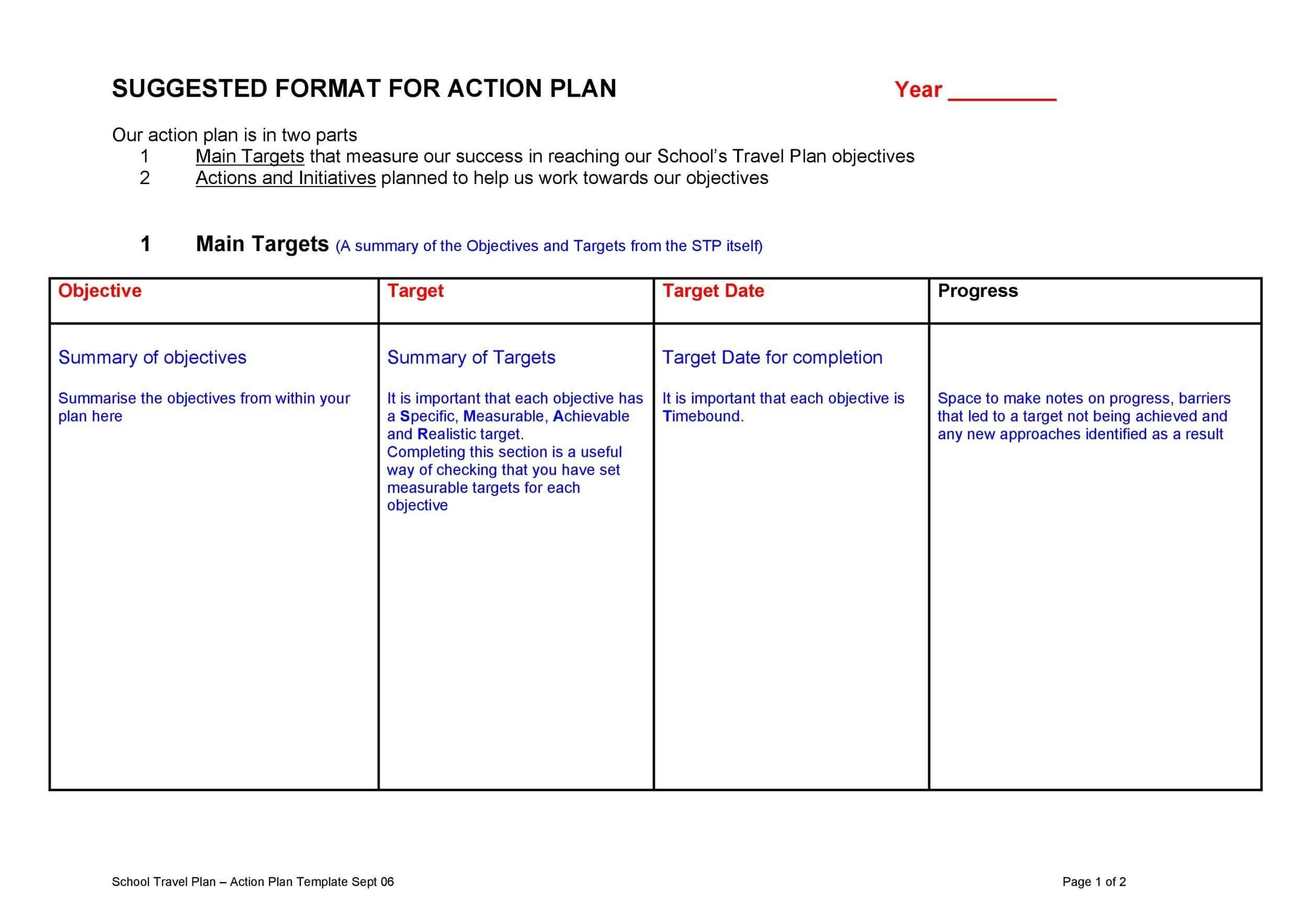
Action Plan Template Example

Click on the download button and make this action plan template your own.





Related templates you may find useful: free contingency plan templates, free sales plan templates and free personal development plan templates.


