
A survey consists of a set of questions that are being asked for knowing more about the product or services. You can download free sample survey templates here in this article. There are many companies that get these sample surveys done so that they can get actual feedback about their services, products, and brands. Such a type of survey also helps the companies to improve their services and when these surveys are done with the help of professional media and advertising companies, it can yield excellent results for the company.
You can also browse our full collection of free survey templates for more ready-to-use designs.
There is a definite objective behind a sample survey and different types of sampling are being done these days. Some common examples are probability sampling and non-probability sampling. Every type of sampling has its own meaning and benefits and such surveys can really prove to be of immense value for the companies for which these are being conducted. There are simple yes/no surveys and there are sometimes multiple-choice question-based sample surveys that are conducted. By checking the given survey templates, you will easily understand the significance of this document.
More About Survey Template
A sample survey is a kind of survey conducted by using a sample or a portion of the population in order to calculate desired parameters. A survey is one of the best strategies to collect information about a population with the help of a sample (a portion of the population). The sample is just a portion of this population, which is selected using assertive statistical principles known as sampling designs. A portion of a specific population (sample) may not provide accurate results but it helps a lot in decision making.
It is very easy and possible to conduct a sample survey smoothly and rapidly also cost-effective than all other surveys. There are various websites that can help you to create your survey within minutes. Simply download sample survey templates and make changes as per your needs. It is very easy to edit such templates and make them as you desired.
Types of Sample Surveys
Sample surveys generally fall into two broad families. Probability sampling gives every member of the target population a known chance of being selected, which makes the results statistically representative and lets you calculate a margin of error. Common probability methods include simple random sampling, stratified sampling (dividing the population into subgroups before sampling from each), and cluster sampling (sampling whole groups rather than individuals). Non-probability sampling, on the other hand, relies on convenience or judgment rather than randomization, for example surveying whoever happens to respond to an email blast or a link on social media. Non-probability surveys are faster and cheaper to run, but the results can’t be generalized to the whole population with the same confidence. Choosing the right approach depends on how precise your conclusions need to be and how much time and budget you have.
What Belongs in a Good Survey Template
A well-structured survey usually opens with a short introduction explaining who is running it and roughly how long it will take, since respondents are more likely to finish a survey when they know what to expect. The body typically mixes a few question types: closed-ended questions (yes/no or multiple choice) that are quick to answer and easy to tally, rating-scale questions (such as a 1-to-5 or 1-to-10 scale) that measure satisfaction or agreement, and a small number of open-ended questions that let respondents explain their answer in their own words. Most templates group related questions under clear headings, such as “Product Experience” or “Customer Service,” so the survey feels organized rather than like a long, undifferentiated list. A closing section for optional demographic details and a thank-you message rounds out a complete template.
How to Customize a Survey Template
- Pick the template that matches your goal, such as employee engagement, customer satisfaction, or market research.
- Replace the placeholder company and product names with your own.
- Trim or add questions so the survey only covers what you actually need to learn.
- Decide on a consistent rating scale (for example, always 1 to 5) so results are easy to compare across questions.
- Keep the survey short; response rates drop sharply once a survey takes more than five to ten minutes to complete.
- Test the survey on a small group first to catch confusing wording before sending it out widely.
Best Practices for Distributing a Survey
- Send the survey through the channel your audience actually uses, whether that’s email, a printed handout, or a link shared in an app.
- Offer an incentive, even a small one, to improve response rates for longer surveys.
- Send a polite reminder a few days after the first invitation to reach people who missed or forgot about it.
- Guarantee anonymity where appropriate, especially for employee or sensitive feedback surveys, since people answer more honestly when they aren’t worried about being identified.
- Set a clear deadline so responses come in within a useful timeframe for your analysis.
Common Mistakes to Avoid
- Asking leading questions that push respondents toward a particular answer.
- Combining two questions into one, which makes it unclear what the respondent is actually rating.
- Making the survey too long, which causes people to abandon it before finishing.
- Using inconsistent rating scales from one question to the next, which complicates analysis later.
- Failing to pilot test the survey, so confusing questions only get discovered after the results come back skewed.
Frequently Asked Questions
How many questions should a sample survey have?
Most effective surveys stay between 10 and 20 questions. Shorter surveys generally get higher completion rates, so it’s worth cutting anything that isn’t essential to your goal.
What’s the difference between a survey and a questionnaire?
The terms are often used interchangeably, but a questionnaire technically refers to the list of questions itself, while a survey is the whole process of collecting and analyzing responses to that questionnaire.
Should surveys be anonymous?
For sensitive topics like employee satisfaction, anonymity generally leads to more honest responses. For customer feedback tied to a specific order or account, identifying the respondent can help with follow-up, so it depends on the goal of the survey.
Can I edit these templates in Word?
Yes, the templates on this page are provided in Word format so you can open them directly, replace the placeholder text with your own questions, and adjust the layout before printing or converting them to a digital survey tool.
Download Sample Survey Templates Here:
Sample Survey Template for Team-Player

Free Employee Engagement Survey Template

Survey Template of Market Research

Sample Telephone Survey Template WORD

Printable Standard Survey Template
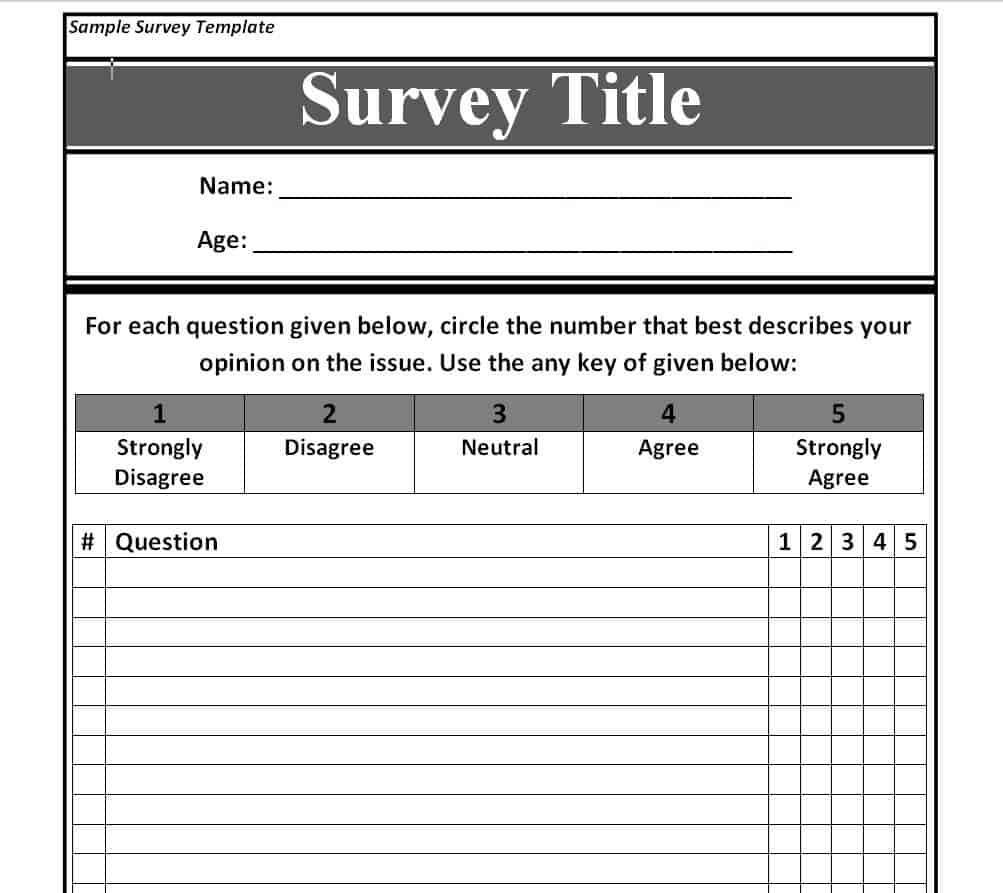
Employee Satisfaction Survey WORD Template

Editable Consumer Questionnaire Survey Template

Company’s Motivtion Survey Template DOC Format

Survey Questionnaire Template WORD

Workshop/Training Survey Template

Practical Customer Satisfaction Survey Questionnaire Example

Related templates you may find useful: free satisfaction survey templates, free profit and loss statement templates and free executive summary templates.