

A general ledger is the primary accounting record of a company and the foundation for preparing its financial statements. It is a complete record of every financial and accounting transaction the business makes, organized by account rather than by date alone. A general ledger helps a business prepare other core financial statements, including the balance sheet, the income statement, and a summary of assets, liabilities, and owner’s equity.
A general ledger should be prepared carefully, with every entry recorded accurately, including the date, a description of the transaction, a reference or voucher number, and the amount involved. Most businesses use double-entry bookkeeping, in which every transaction is recorded twice: once as a debit and once as a credit. When the ledger is kept correctly, the total of all debit entries always equals the total of all credit entries, which provides a simple built-in check on accuracy.
Because the general ledger is used to prepare the organization’s financial statements, it also helps different departments assess the company’s overall financial position. Keeping an accurate, up-to-date general ledger is important for businesses of every size, from a small sole proprietorship to a large corporation, because it keeps day-to-day business affairs organized and auditable. This General Ledger Template is designed to make that process easier.
You can also browse our full collection of free word templates for more ready-to-use designs.
The general ledger is the book (or, more commonly today, the spreadsheet or accounting-software file) in which a complete record of every transaction made during the accounting period is kept. Transactions can vary in nature, for example a cash sale, a credit purchase, a loan repayment, or a payroll payment, but each one is posted to the relevant account in the ledger. A typical entry includes the transaction date, a description or product/customer name, a voucher or reference number for the supporting document, and the running balance for that account. Once transactions are posted, the ledger is summarized into account balances, which are then used to check that total debits equal total credits before the figures are carried into the financial statements.
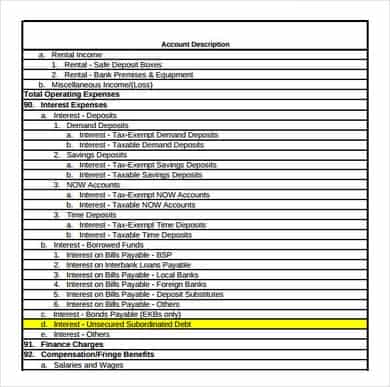
A general ledger is normally organized around a standard set of account categories: assets, liabilities, equity, revenue, and expenses. Each of these categories can be broken down further into individual accounts, for example “Cash,” “Accounts Receivable,” “Accounts Payable,” “Sales Revenue,” or “Office Supplies Expense.” A general ledger is typically maintained by an accountant or bookkeeper, and every entry that appears in the individual account ledgers is ultimately drawn from, and reconciled against, the general ledger. Both public and private sector organizations rely on a general ledger to keep their financial records organized and auditable.
Key Sections of a General Ledger Template
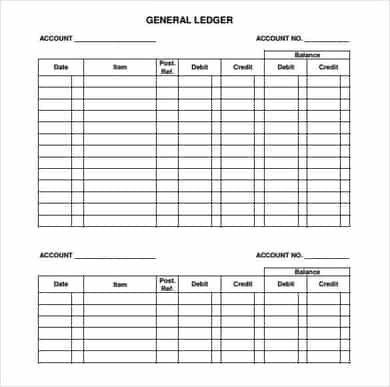
A well-designed general ledger template usually includes the following columns for each account:
- Date – the date the transaction occurred or was recorded.
- Description/Particulars – a short explanation of the transaction, such as the customer, supplier, or purpose of the entry.
- Reference or Voucher Number – a link back to the invoice, receipt, or voucher that supports the entry.
- Debit – the amount recorded on the debit side of the account.
- Credit – the amount recorded on the credit side of the account.
- Balance – the running balance of the account after each entry.
Some templates group several accounts on one sheet, while others use a separate ledger page (or tab, in a spreadsheet) for each account. Either approach works, as long as the structure is consistent and every entry can be traced back to its supporting document.
General Ledger vs. General Journal
The general ledger is often confused with the general journal, but the two serve different purposes. The general journal is where transactions are first recorded, in date order, as they happen. The general ledger then organizes those same transactions by account, so that a business can see, for example, the complete history of its “Cash” account or its “Sales Revenue” account in one place. In practice, journal entries are posted, or transferred, into the corresponding ledger accounts on a regular basis, such as daily or weekly.
How to Fill In This General Ledger Template
- Set up your accounts. List the accounts your business needs, such as cash, accounts receivable, accounts payable, revenue, and the main expense categories.
- Enter the opening balance. Carry forward the closing balance from the previous period for each account.
- Record each transaction. For every transaction, enter the date, a short description, the reference/voucher number, and the debit or credit amount in the appropriate account.
- Update the running balance. Recalculate the balance for the account after each entry.
- Reconcile debits and credits. At the end of the period, confirm that total debits equal total credits across all accounts.
- Use the totals to prepare financial statements. The final account balances feed into the trial balance, income statement, and balance sheet.
Common Mistakes to Avoid
- Missing reference numbers. Without a voucher or invoice reference, it becomes difficult to verify an entry later.
- Recording only one side of a transaction. Every transaction needs both a debit and a matching credit entry; forgetting one breaks the double-entry check.
- Inconsistent account names. Using different names for the same account (for example, “Office Supplies” in one entry and “Supplies Expense” in another) makes totals harder to track.
- Delaying entries. Posting transactions long after they happen increases the risk of errors and missing information.
- Not reconciling regularly. Waiting until year-end to check that debits equal credits makes it much harder to find and fix a mistake.
A Note on Professional Review
This general ledger template is intended as a general-purpose starting point for organizing your business’s transactions, not as a substitute for professional accounting advice. Bookkeeping and reporting requirements can vary by jurisdiction, industry, and business structure, so for statutory filings, tax reporting, or audited financial statements, have a qualified accountant or bookkeeper review your chart of accounts and ledger setup to confirm it meets your specific obligations.
Frequently Asked Questions
What is a general ledger used for?
A general ledger is used to record and organize every financial transaction of a business by account, so that the totals can be used to prepare the trial balance, income statement, and balance sheet.
What is the difference between a general ledger and a general journal?
The general journal records transactions in the order they occur. The general ledger organizes those same transactions by account, making it easier to see the full activity and balance of each individual account.
Can I use this template in Excel?
Yes. The general ledger template can be opened and edited in Excel or a similar spreadsheet program, which also makes it easy to add formulas for running balances and account totals.
Do I still need a general ledger if I use accounting software?
Most accounting software maintains a general ledger automatically in the background. A template is still useful for smaller businesses, manual bookkeeping, quick reconciliations, or as a backup or teaching reference for how the ledger works.
Download Free General Ledger Template:
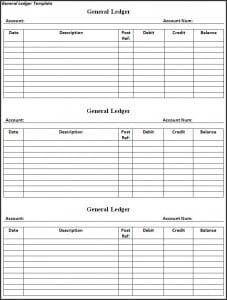
Click on the download button and make this general ledger template your own.

Related templates you may find useful: free non-disclosure agreement templates, free expense report templates and free to do list templates.