

This free Construction Agreement Template is added here for you help. A Construction Agreement is a sort of agreement that consists of all the details as well as the cost of the construction project. Such type of agreement is mainly done for big and complex projects. Many residential and commercial projects require such types of agreement. The main benefit of this agreement is that it ensures systematic following of all the protocols without any sort of legal hindrance. Moreover, the construction and the project engineer are able to keep the cost to the bare minimum under this agreement, which is beneficial for the project. Such agreements can prove to be quite beneficial for commercial projects because the scale is very large and in order to smoothly handle the entire project such agreements are quite necessary. With a properly drafted construction agreement, the real estate companies can smoothly monitor the progress of the project.
Construction agreement is a document which legally bound the both companies to follow the terms and conditions of the agreement drafted by construction companies for their clients. It clearly defines the all rights and obligations of both parties (builder and owner). Usually construction agreement includes important elements: project scope, schedule of work, date of accomplishment and payment details etc. The contract’s date and the names of all parties must provide first in a construction agreement, also list the address, phone, fax, and e-mail and other contact details for each party. If you have no idea that how to prepare a construction agreement, you can utilize construction agreement samples, you can also edit them and can make changes as per your needs. It can allow you to add specicified terms of company or organization. Construction agreement should be in professional manner and must signed by both parties.
What Is a Construction Agreement and Who Needs One?
A construction agreement, also called a construction contract, is a legally binding document that sets out exactly what a contractor will build, how much the owner will pay, and when each phase of work must be finished. It protects both sides by turning verbal promises into enforceable terms, so a disagreement over scope or price can be resolved by checking what was actually signed rather than what someone remembers being said. General contractors and specialty subcontractors use this kind of agreement to lock in price and schedule before mobilizing crews and ordering materials. Homeowners planning a renovation, addition, or new build rely on it to confirm exactly what they are paying for and what recourse they have if the work is late, defective, or over budget. Property developers and commercial owners use it on larger jobs to coordinate multiple trades, track milestone payments, and keep a paper trail for lenders, insurers, and building inspectors. Subcontractors also benefit, since the agreement (or a subcontract that references it) defines their portion of the scope, their payment schedule, and how change orders from the general contractor will be priced and approved.
Key Elements Every Construction Agreement Should Include
A construction agreement only protects the parties who signed it if it actually covers the situations that come up on a real job site. At minimum, look for these core clauses:
- Scope of work – a detailed, itemized description of every task, material, and finish included in the price, so nothing is left to interpretation.
- Payment schedule and milestones – how the total price is broken into deposits, progress payments tied to completed phases, and a final payment held until punch-list items are closed out.
- Project timeline – a start date, an estimated completion date, and how weather, permitting delays, or owner-caused delays affect the schedule.
- Materials and specifications – brand, grade, and quantity of materials, plus who is responsible for ordering and storing them.
- Change order process – a written procedure for pricing and approving any change to the original scope before the extra work begins.
- Warranties – how long the contractor stands behind workmanship and how manufacturer warranties on materials are passed through to the owner.
- Dispute resolution – whether disagreements go to mediation, arbitration, or court, and which state’s law applies.
Leaving any of these out is one of the most common reasons construction disputes end up costing far more than the original project.
Download Construction Agreement Template:
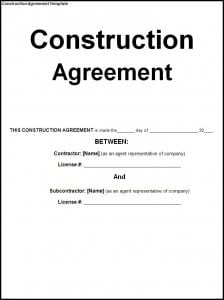
Click on the download button and make this construction agreement template your own.

How to Use This Construction Agreement Template
- Download the format that matches your project (Word or ZIP) using the button above.
- Fill in the identifying details first – legal names, mailing addresses, phone numbers, and email for both the owner and the contractor, plus the project address.
- Write or paste in a detailed scope of work, ideally broken down by phase or trade, so both sides can check the finished work against the same list.
- Set the total contract price and split it into a payment schedule tied to milestones rather than dates alone, so payment follows completed, inspected work.
- Add your project timeline, including a start date and a realistic completion date with any conditions that would extend it.
- Insert the change order language and dispute resolution clause, adjusting them to match your state’s contractor licensing and lien laws.
- Have both parties read the completed agreement, sign, and date it, and keep signed copies (physical or scanned) with the project file.
More Construction Agreement Templates Are Here
1. Housecontractor


2. Vakilno1

3. Agreements
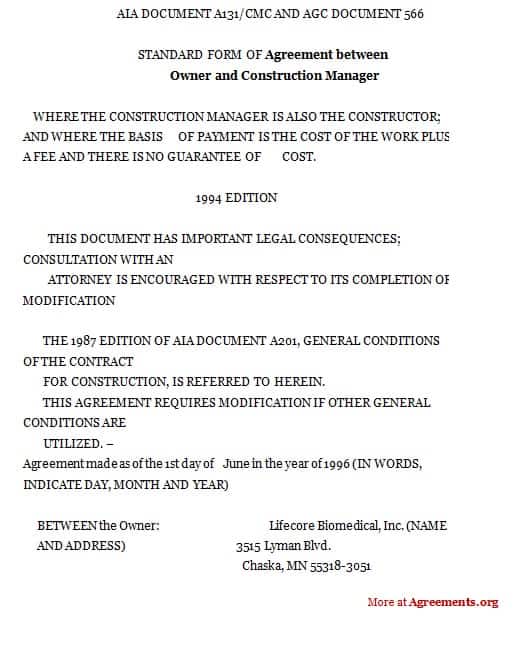
4. Rinkenoonan
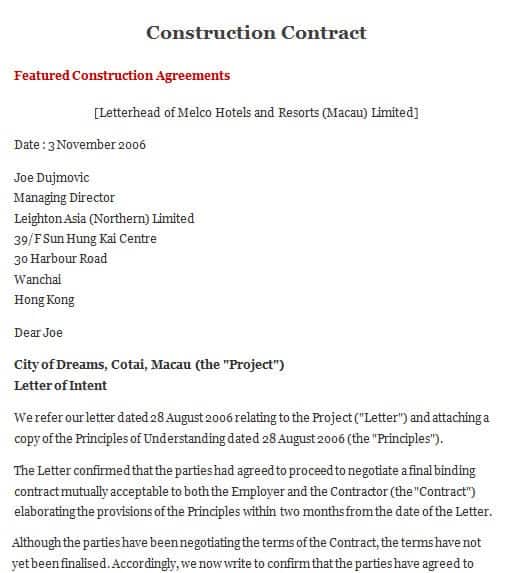
5. Montrosecounty

Common Mistakes to Avoid When Drafting a Construction Agreement
Even a well-designed template can fail to protect you if it is filled in carelessly. The most frequent mistakes include:
- A vague scope of work – phrases like “renovate kitchen” instead of a room-by-room list of materials, fixtures, and finishes invite disputes over what was actually promised.
- No change-order process – verbal agreements to “just add” extra work almost always turn into billing disputes once the invoice arrives.
- Missing or unrealistic timeline – a contract with no completion date, or one that ignores permitting and inspection lead times, gives neither side a way to measure delay.
- Payment tied to time instead of milestones – paying a fixed amount on a fixed schedule regardless of progress removes the owner’s leverage if work falls behind.
- Skipping lien waivers – without a waiver at each payment, a subcontractor or supplier who was not paid can still file a lien against the property even after the owner has paid the general contractor in full.
- Not checking licensing and insurance – signing before confirming the contractor’s license number and current liability and workers’ compensation coverage leaves the owner exposed if something goes wrong on site.
Practical Tips: Permits, Insurance & Lien Waivers
Before work begins, confirm which permits the project needs and who is responsible for pulling them – building, electrical, plumbing, and mechanical permits are commonly required for anything beyond cosmetic work, and building without one can force costly rework later. Ask the contractor for a current certificate of general liability insurance and, where employees are on site, workers’ compensation coverage, and verify both are still active rather than relying on a certificate from a previous job. In states that allow mechanic’s liens, request a conditional lien waiver with each progress payment and an unconditional waiver once that payment clears, so subcontractors and material suppliers formally acknowledge they were paid and give up their right to place a lien for that amount. Keep every signed change order, payment receipt, and inspection report in one project file; if a dispute ever needs to go to mediation or court, that paper trail is what actually settles who is right.
Frequently Asked Questions
Is a construction agreement template legally binding?
Yes. Once both parties fill it in with accurate project details, agree on the terms, and sign it, it functions as a binding contract in the same way a custom-drafted agreement would, provided it complies with your state’s contract and licensing requirements.
Can I edit this template for my specific project?
Yes. The template is meant to be a starting point – add or remove clauses, adjust the payment schedule, and insert project-specific scope details so the final document matches exactly what was agreed with your contractor or client.
What format does the download come in?
This template downloads as a Word/ZIP file, so you can open it in Microsoft Word or a compatible word processor and edit the text directly before printing or sending it for signature.
Do I need a lawyer to use a construction agreement template?
A template can cover most standard residential and small commercial projects, but for large, complex, or high-value projects, it’s worth having a licensed attorney review the filled-in agreement before signing, especially the payment, warranty, and dispute resolution clauses.
Disclaimer: This template is provided for general informational purposes and is not a substitute for legal advice. Consult a qualified attorney or licensed professional before finalizing any construction agreement.

![10+ Excellent Yearly Calendar Templates [Doc, Excel, PDF]](https://www.docspile.com/wp-content/uploads/2023/03/yearly-calendar-template-docp-fsij24342sda2306-150x150.png)