

A Likert scale is a commonly used rating scale for measuring people’s opinions, attitudes, perceptions, satisfaction, or level of agreement with a statement. It is frequently used in surveys, questionnaires, customer feedback forms, employee surveys, academic research, and market research.
A Likert scale template makes it easier to create a structured questionnaire without designing the rating system from scratch. Instead of creating each question and response option manually, you can use a ready-made format and customize the statements, scale points, and instructions for your survey.
Likert Scale Templates
A typical Likert scale presents a statement or question followed by several response options. A respondent selects the option that best represents their opinion or experience.
One of the most common formats is a 5-point Likert scale, such as Strongly Disagree, Disagree, Neutral, Agree, and Strongly Agree. Other versions may measure satisfaction, frequency, importance, quality, or likelihood. The scale should match what you are actually trying to measure.
5-Point Likert Scale
A 5-point Likert scale provides five response choices and is widely used because it gives respondents a neutral middle option while keeping the questionnaire relatively simple.
For an agreement question, the choices might range from Strongly Disagree to Strongly Agree. For a satisfaction survey, the same five points could instead range from Very Dissatisfied to Very Satisfied. Use consistent wording throughout the questionnaire so respondents understand how to interpret the scale.
7-Point Likert Scale
A 7-point Likert scale provides more response options than a five-point scale and can capture finer differences in respondents’ opinions. It may be useful when a survey requires greater differentiation between levels of agreement or satisfaction.
A larger number of response choices can also make a questionnaire more demanding for respondents. Choose the number of points based on your research objectives and audience rather than assuming that a longer scale is always better.
Likert Scale Survey Template
A Likert scale survey template can be used to measure customer satisfaction, employee engagement, product opinions, service quality, attitudes, or other measurable perceptions.
Begin by defining what you want to measure. Then write clear statements or questions and provide the same response scale where appropriate. Avoid combining multiple ideas in one statement because respondents may agree with one part but disagree with another.
Likert Scale Questionnaire
A Likert scale questionnaire usually contains several related statements that measure a particular topic or construct. For example, an employee survey might include statements about workplace communication, while a customer questionnaire might measure satisfaction with different aspects of a service.
Keep each statement concise and easy to understand. Avoid unnecessary technical language, leading questions, and ambiguous wording. Clear questions generally produce more useful responses.
Likert Scale in Word and Excel
A Likert scale template in Word is useful when you want to create a printable questionnaire or an editable survey document. You can modify the questions, response choices, headings, and instructions before distributing the form.
An Excel Likert scale template can be useful when responses need to be entered and organized digitally. A spreadsheet can help arrange respondents and questions in rows and columns and can support later analysis of the collected responses.
Likert Scale Examples
Likert scales can measure different types of responses. For example:
- Strongly Disagree to Strongly Agree
- Very Dissatisfied to Very Satisfied
- Never to Always
- Very Unlikely to Very Likely
- Not Important to Extremely Important
- Very Poor to Excellent
Choose response labels that directly match the question. If you are measuring frequency, agreement labels may not be appropriate. If you are measuring satisfaction, use satisfaction-related choices.
How to Create a Likert Scale Survey
Start by identifying the objective of the survey. Decide exactly what you want respondents to evaluate and choose an appropriate rating scale.
Write short, specific statements and use consistent response options. Review the questions for ambiguity or bias, then test the questionnaire with a small group if possible. After collecting responses, analyze the results using a method appropriate for your research design.
Common Likert Scale Mistakes to Avoid
A few recurring mistakes can weaken the quality of a Likert scale survey. Asking a “double-barreled” question that combines two ideas in one statement makes it hard for respondents to give a single accurate answer. Mixing positively and negatively worded statements without labeling them clearly can also confuse respondents and complicate scoring later.
Other common issues include using an uneven number of response options, switching scale labels partway through a survey, and making the questionnaire too long. Keeping statements short, using one consistent scale per section, and piloting the survey with a small group before full distribution can help catch these problems early.
Download Free Likert Scale Templates
These free Likert scale templates provide ready-made formats for surveys, questionnaires, feedback forms, academic research, customer surveys, and employee assessments. You can customize the statements and response options according to your specific requirements.
Whether you need a 5-point Likert scale, 7-point scale, printable questionnaire, Word document, or Excel format, a structured template can save time and help you create a more consistent survey.
25 Free Likert Scale Templates in one Click:

Download 2 Free Likert scale templates with Snapshots:
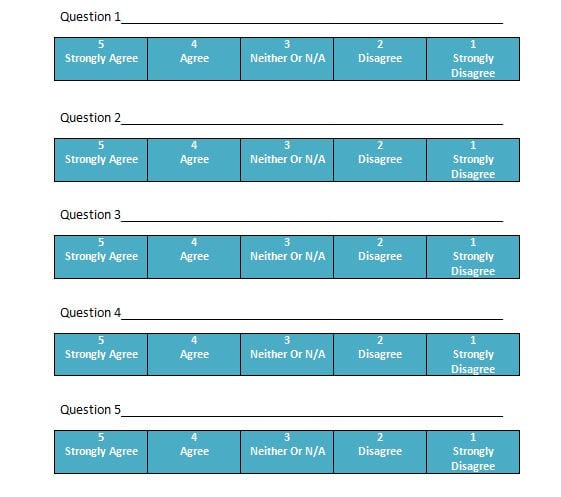
This Likert scale template provides a structured format for creating survey questions with predefined response options. It can help organize statements and rating choices so respondents can consistently indicate their opinions or level of agreement.
The template can be customized for customer feedback, employee surveys, academic research, product evaluations, or other questionnaires. Replace the sample statements with questions relevant to the specific survey objective.


Likert Scale Survey Template
This Likert scale survey template provides a convenient starting point for building a questionnaire based on rating responses. It can be adapted to measure agreement, satisfaction, frequency, importance, likelihood, or other suitable variables.
Use consistent response labels throughout related questions and make sure the scale matches what each question is asking respondents to evaluate. A clear format can make the questionnaire easier to complete and analyze.
FAQs
1. What is a Likert scale?
A Likert scale is a rating scale used to measure opinions, attitudes, perceptions, satisfaction, or levels of agreement with statements.
2. What is a 5-point Likert scale?
A 5-point Likert scale provides five response options, commonly ranging from Strongly Disagree to Strongly Agree.
3. What is a 7-point Likert scale?
A 7-point Likert scale provides seven response choices, allowing respondents to express more gradual differences in their opinions.
4. What is a Likert scale questionnaire?
It is a questionnaire containing statements or questions that respondents rate using a defined set of response options.
5. Can I create a Likert scale in Word?
Yes. Word is useful for creating editable or printable Likert scale questionnaires and survey forms.
6. Can I use Excel for a Likert scale?
Yes. Excel can be used to organize Likert survey questions and record responses for later analysis.
7. What are common Likert scale response options?
Common options include Strongly Disagree to Strongly Agree, Very Dissatisfied to Very Satisfied, and Never to Always.
8. How many points should a Likert scale have?
Five and seven points are common choices, but the appropriate number depends on the survey objective, audience, and type of response being measured.