

You can download free Software License Agreement Templates here. It is a kind of agreement between owner or manufacturer of a software and consumer in which a consumer asked to agree all terms and conditions of software regarding its usage. Generally when you purchase or download software you are asked to agree all terms and conditions of software license first. In other words, a software license is a permission to buyer to use software according to the instructions provided by company or manufacturer. A software license agreement may include terms and conditions of use, requirements to use software effectively, copyrights and other instructions to use it smoothly. Software licensing can come in the form of either a paper document or an online document. Software license agreement may have single user license grant and multiuser license grant. If you need to prepare a software license agreement, you should use software license agreement templates. Such templates allow us to make changes in them in order to make a perfect software license agreement yourself. You will like this Software License Agreement Template.
A Software License Agreement is a sort of agreement that is being made between the software manufacturer and its buyer. This type of agreement is generally made so that no fake copy of the software can be made and failure to do so might result into legal proceedings. Such agreements are generally made as per the government rules and regulations and if you are looking for a software license agreement format then you can easily get it from the internet. All you need to do is to take the help of your favorite search engine and host of options will be presented in front of you. Such software agreements also help the software companies from losses as nobody can make a fake copy of their software. Some software are quite advanced and hence a patent is required to be filed with concerned authorities.
Who Uses a Software License Agreement?
Software license agreements are used by a wide range of parties whenever software changes hands from a creator to a user. Software vendors and publishers rely on them to protect their intellectual property while still allowing customers to install and run their products. Independent developers and small software studios use a license agreement to formalize how a client, employer, or end user may use code they have written, whether it is sold outright, licensed for a subscription period, or distributed for free with conditions attached. Businesses that purchase software for internal use also depend on these agreements, since the terms determine how many employees may use the program, whether it can be installed on multiple devices, and what happens to that access if the company stops paying for support. IT departments and procurement teams typically review a software license agreement before approving a purchase, because the document spells out liability, data handling, and renewal terms that affect the organization long after installation.
Key Elements a Software License Agreement Should Contain
A well-drafted software license agreement is more than a formality — it is the document both sides rely on if a dispute ever arises. At a minimum, it should address the following:
- Grant of License: States exactly what rights are being given, such as whether the license is exclusive or non-exclusive, single-user or multi-user, and whether it applies to one device or an entire organization.
- Restrictions on Use: Clarifies what the licensee may not do, including reverse engineering, reselling, sublicensing, or modifying the source code without written permission.
- Ownership and Intellectual Property: Confirms that the software publisher retains ownership of the underlying code, trademarks, and copyrights, while the buyer only receives a right to use it.
- Fees and Payment Terms: Outlines the license fee structure, whether it is a one-time purchase, a recurring subscription, or a tiered pricing model based on usage.
- Warranty and Disclaimers: Describes any performance guarantees the vendor offers, and just as importantly, what is explicitly excluded, such as “as-is” software with no guarantee of fitness for a particular purpose.
- Limitation of Liability: Caps the vendor’s financial exposure if the software causes data loss, downtime, or other damages, which protects the publisher from open-ended claims.
- Term and Termination: Sets the duration of the license and the conditions under which either party can end the agreement, such as non-payment or breach of the restrictions clause.
- Support and Updates: Specifies whether technical support, bug fixes, or version upgrades are included in the license or sold separately.
- Governing Law: Identifies which state or country’s laws will apply if a disagreement ends up in court.
Download Software License Agreement Templates:
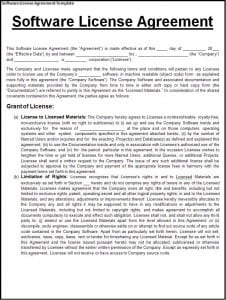
Click on the download button and make this software license agreement template your own.

View Resources For Free Software License Agreement Templates Here
1. RocketLawyer


2. UpCounsel
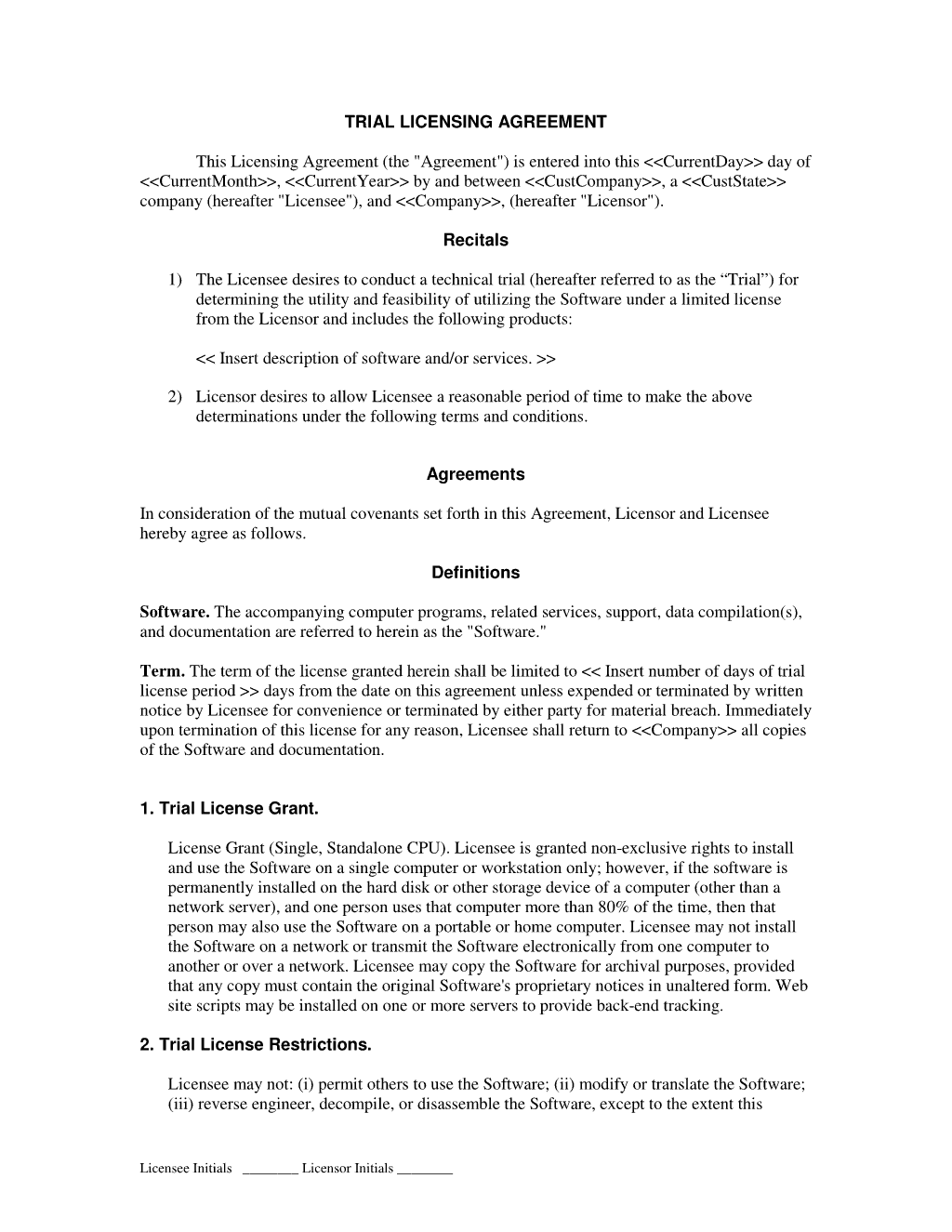
3. FindLaws

4. LawDepot
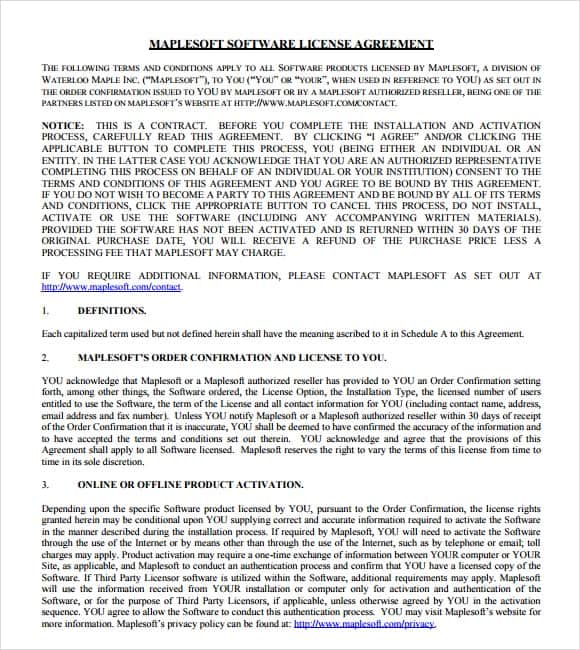
5. SeqLegal

How to Create a Software License Agreement: A Step-by-Step Guide
- Choose a starting template. Download one of the templates listed above rather than starting from a blank page, so the standard clauses are already in place.
- Identify the parties. Fill in the full legal names and addresses of the licensor (the software owner) and the licensee (the person or company receiving the license).
- Define the scope of the license. Specify whether it is a single-user or multi-user license, the number of permitted installations, and whether the license is perpetual or time-limited.
- Add usage restrictions and IP protections. List what the licensee cannot do, such as copying, redistributing, or reverse engineering the software, and confirm that ownership stays with the licensor.
- Insert fees, warranty, and liability terms. Enter the license fee or subscription cost, any warranty the vendor is offering, and a liability cap that matches the value of the transaction.
- Review and sign. Have both parties read the finished document carefully, ideally after a legal professional has reviewed it, before signing and keeping a copy on file.
Common Mistakes to Avoid
- Using a generic template without adjusting the license scope, which can leave the number of permitted users or devices undefined.
- Leaving the liability and warranty sections blank, which exposes the software vendor to open-ended claims if something goes wrong.
- Forgetting to specify what happens to the license if the software company is acquired or the product is discontinued.
- Skipping the termination clause, which makes it unclear how either party can exit the agreement if terms are violated.
- Not clarifying whether updates, patches, and customer support are included in the license fee or billed separately.
Practical Tips
- Match the license type to how the software will actually be used — a single-user license is not appropriate for a whole department.
- Keep a signed copy of every license agreement alongside your software inventory so renewals and audits are easier to manage.
- Revisit the agreement whenever the software is upgraded to a new major version, since license terms sometimes change between releases.
- If you are licensing software to others, make the restrictions section specific rather than relying on vague language that is hard to enforce.
Frequently Asked Questions
Is a software license agreement the same as a purchase agreement?
No. A purchase agreement transfers ownership of goods, while a software license agreement only grants the right to use the software under specific conditions — the publisher still owns the underlying code.
Can I edit these templates for my own business?
Yes. Each template above is meant to be downloaded and customized with your own company name, license terms, fees, and jurisdiction before it is used.
Do I need a lawyer to use a software license agreement template?
A template is a helpful starting point, but having a legal professional review the final document is strongly recommended, especially for agreements involving significant fees or multiple users.
What is the difference between a single-user and a multi-user license?
A single-user license permits one person or one device to run the software, while a multi-user license allows a defined number of people or devices, often at a higher fee that scales with usage.
Disclaimer: The templates and information on this page are provided for general informational purposes only and do not constitute legal advice. Software licensing needs vary by jurisdiction and industry, so consult a qualified legal professional before finalizing or signing any software license agreement.
